
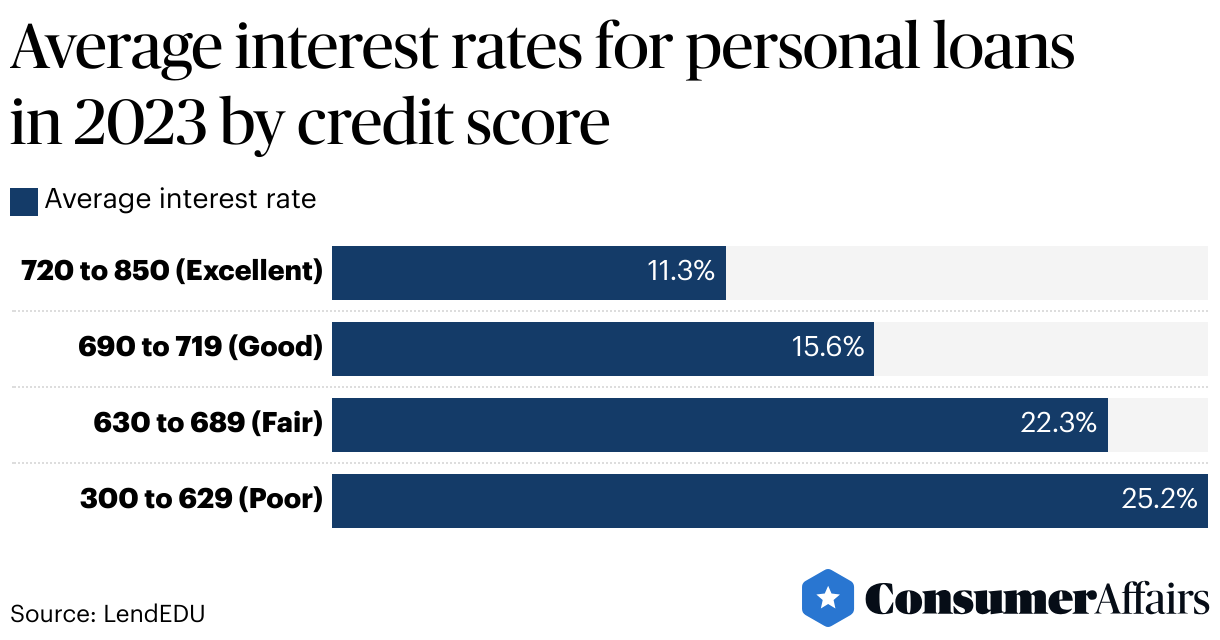
We looked at fifty-nine different companies to find the best options for people with less-than-stellar credit. The results show a massive gap in interest rates and repayment terms. It isn’t a level playing field. If you walk into a lender’s office with a 750 score, you’re treated like royalty. If you show up with a 550, you’re just a math problem that might not resolve.
The math is brutal. We see it every month. According to Forbes Advisor, a borrower with very good to excellent credit (740 and up) can generally expect the best rates, between 6% and 10% APR. That is a huge gap. It’s the difference between a loan that helps you consolidate debt and a loan that becomes a second debt.
The reality is that your score is the main dial that determines how much your money costs. It’s a blunt instrument. It doesn’t care if you lost your job because of a medical emergency or a freak accident. It only sees the number. If that number is low, the interest rate climbs. If it’s high, the rate drops. It’s simple, and it’s often unfair.
After spending enough time looking at these spreadsheets, we know “one size fits all” is a lie. You can’t compare a SoFi offer to an OneMain Financial offer and expect them to be in the same universe. They are playing different games with different rules.
The High-Score Advantage and the 740 Threshold
If you have a credit score of 740 or higher, you’re in the elite tier. Lenders will actually compete for your business. They want your low-risk profile because it makes their internal spreadsheets look good. You can find rates hovering around 6%, which is about as cheap as unsecured money gets in this economy.
At this level, you have leverage. You should shop around between lenders like SoFi, Upgrade, and Discover to see who offers the best terms. Don’t just look at the APR; look at the fees. Some lenders charge an origination fee that eats up a chunk of your loan before you even see the money in your bank account.
Take Marcus, for example. He needed $15,000 for a kitchen renovation. Because his score was 785, he got a rate of 7.2% with no origination fee. If Marcus had a score of 620, that same $15,000 might have cost him $11,000 in total interest over the life of the loan. That’s a massive difference for a single piece of kitchen hardware.
The strategy for high-score borrowers is simple: shop. Don’t take the first offer that hits your inbox. Use a soft credit pull to compare rates across different platforms. You have the power here. Use it.
Even with a great score, your debt-to-income ratio still matters. A high score isn’t a blank check. Lenders still want to see that you can actually afford the monthly payment without skipping rent or groceries.
The Mid-Tier Struggle and the 580 Wall
The 580 score is a psychological and financial border. For those hovering around this number, your options change overnight. You move from “premium” lenders to “specialty” lenders. You stop being a preferred client and start being a risk assessment.
Lenders like Upstart, Avant, and OneMain Financial tend to step into this arena. They use different data points to decide if you are a safe bet. While a traditional bank might look strictly at your FICO score, these lenders might look at your bank account history or your educational background to fill in the gaps. It’s a more nuanced approach, but it comes with a cost.
Rates for this group are rarely “good.” They are “functional.” You are paying for the privilege of access. If you’re stuck in this middle ground, your goal shouldn’t be finding the lowest rate, but finding the most reasonable terms. You want to avoid terms that trap you in a cycle of refinancing.
Check your terms carefully. Some lenders in this space offer high amounts but charge heavy prepayment penalties. You don’t want to be stuck paying a fine just because you finally got a raise and wanted to pay off your debt early.
- Mid-Tier Lenders: Often require a mix of traditional credit and income verification.
- Interest Rates: Usually significantly higher than the 6-10% range.
- Loan Amounts: Can be smaller, making them better for quick debt consolidation.
- Repayment: Terms are usually standard, but check for hidden fees.
If you find yourself here, Jetzloan and similar services might be part of the conversation, but you must remain vigilant about the total cost of capital.
The Survival Guide for Scores Under 580
When your score dips below 580, many traditional doors slam shut. This is where the “bad credit” market becomes most visible. It’s a niche sector of the financial world. It isn’t glamorous, and it’s certainly not cheap. But it is a vital resource for people who need to consolidate high-interest credit card debt into a single, manageable payment.
According to research from Investopedia, Upgrade has emerged as a top contender for those in this category. When you are dealing with poor credit, the lender is essentially betting that you will use this loan to fix your financial life, not deepen your hole. They are looking for a trajectory of improvement, not just a static number.
You might find lenders that have no minimum score requirements. These are lifelines. But be warned: the interest rates can be astronomical. You are essentially paying a “risk premium.” In some cases, the APR can approach the limits allowed by state usury laws. It’s a dangerous line to walk.
We suggest a specific approach for this tier. Do not borrow for a lifestyle purchase. Do not borrow to buy a car you cannot afford. Only borrow to consolidate debt that is currently costing you more in interest than this new loan will. If you use a bad credit loan to buy a vacation, you are effectively setting your financial house on fire to stay warm for one night.
| Credit Tier | Typical Score Range | Lender Profile | Primary Focus |
|---|---|---|---|
| Excellent | 740+ | Major Banks / SoFi | Lowest APR / Best Terms |
| Good/Fair | 670 – 739 | Credit Unions / Discover | Balance of Rate and Speed |
| Poor | Below 580 | Specialty Lenders | Access to Capital |
The goal for anyone in this tier should be rapid improvement. Every month you make your payments on time, that score moves. Your first goal is to get from “Poor” to “Fair,” then “Fair” to “Good.” Each jump is a permanent pay raise in the form of lower interest rates.
Comparing the Math: APR vs. Total Cost
The biggest mistake people make is looking at the monthly payment and ignoring the total cost. A lender might offer you a $10,000 loan with a $200 monthly payment. That sounds manageable. But if that loan is stretched over 60 months, you are paying $12,000 total. If the term is 72 months, you are paying $14,400. You just paid $4,400 for the privilege of a lower monthly bill.
The APR (Annual Percentage Rate) is a better metric because it includes the interest and most of the fees. If you are comparing two loans, the APR is your best friend. It tells you the true cost of the money. If one lender says 12% and another says 14% but the first one has a massive origination fee, the 14% might actually be the cheaper option.
We often see borrowers get caught in the “monthly payment trap.” They want to keep their budget tight, so they extend the loan term as long as possible. This is a slow leak in your financial ship. It is better to pay a slightly higher monthly amount for a shorter period than to pay a tiny amount for a decade. Time is the enemy of the borrower.
It’s a hard lesson to learn. You have to look at the long-term math. If you can afford to pay $350 a month instead of $250, do it. That extra $100 goes straight to the principal. It cuts months, sometimes years, off the end of your loan. It’s the most effective way to reclaim your financial freedom.
The math doesn’t lie. Numbers are cold. They don’t care about your feelings or your intentions. They only care about the principal and the rate. Master the math, and you master your debt.
You might still be wondering if a personal loan is even worth the hassle if your credit is bad. If you are using the loan to consolidate high-interest debt that is currently suffocating you, the answer is a resounding yes. If you are using it to spend money you don’t have, the answer is no.